
Managed IT support for schools
The best support is the call you never make.
Response times are easy to promise. Great IT support goes further. It means spotting problems before they disrupt learning, having engineers who know your school, and giving you a clear technology plan that supports your priorities and future development.

What’s included
Six things that make up the service around your school.

Remote helpdesk and on-site support
A helpdesk your staff can actually reach, and named engineers on site on agreed days. Co-managed alongside your own team, or the whole thing, depending on what you need.

Proactive monitoring and management
Remote monitoring and management across servers, switches and endpoints, so patching, disk failures and failed backups are dealt with before anybody opens a ticket.
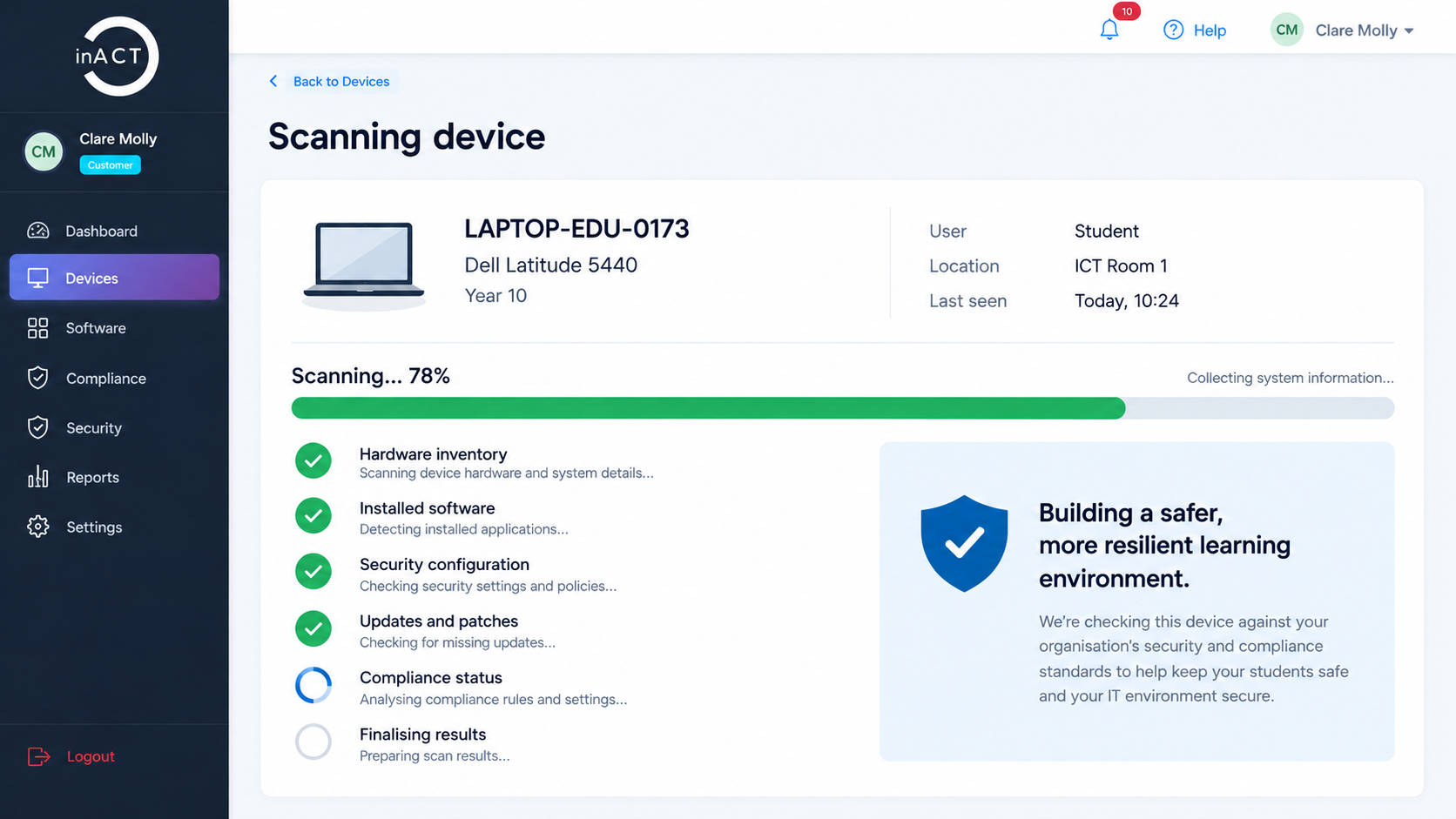
Asset and lifecycle management
Every device tracked with its age, warranty and replacement date in inACT, so refresh becomes a budget line rather than an emergency.

IT procurement
Specification, pricing and purchasing, using education pricing and framework routes wherever they save you money rather than wherever they suit us.

IT strategy and consultancy
A three to five year technology strategy, costed and staged, with progress against the DfE standards and cost per pupil reported in language a board will follow.

Decant and relocation
Moving a school, a block or a server room, surveyed before anything is unplugged and planned around term dates rather than ours.
Start where you are
Choose your institution…
Independent schools
Bursars are judged on value as much as cost. Predictable spend and no surprises matter more than the lowest quote.

State schools
One person is usually holding all of it. This is the part that comes off their plate first.

Multi-academy trusts
Academy onboarding, one service desk across every school, and cost per pupil reported consistently instead of school by school.

SEND Settings
Consistency of staff matters more here than anywhere. The same engineers, familiar to your pupils.

New Build
Support that starts on handover day rather than three months later once the contractor has gone.

Training
Buying it is
the easy part.
Schools buy the right technology all the time and never find out what it does. Every solution we deliver comes with training for the people who’ll actually use it, built around how your staff work rather than a manual left on a desk. Run on site or remotely, and repeated when new staff arrive.
Key partners we work with.
The vendors behind your security stack, chosen because they hold up in a school rather than because of a reseller agreement.


















Related reading

The support model that wasn’t working
The school had support. What it didn’t have was enough time, enough flexibility or enough value from it. For years, the formula seemed simple. If you want good IT support, you need engineers onsite. The more days onsite, the better the service. At least that’s what many schools believed.
Read more about The support model that wasn’t working
The password problem
Before the school day even starts, teachers have already signed in to multiple different systems. One for email. One for…
Read more about The password problem
The parent who called three times
Getting through shouldn’t be difficult. But as the trust grew, so did the complexity of their communications. For many multi-academy…
Read more about The parent who called three timesFAQs
What schools ask us most about support and IT management.
Can you work alongside our existing IT team?
Yes, and most of our larger schools do exactly that. Co-managed IT is normal for us. Your team keeps the relationships and the day-to-day, we bring capacity, specialists and out-of-hours cover, and we hand work back cleanly rather than quietly accumulating it.
Can you produce a three to five year technology strategy?
Yes, and it is the part most schools tell us they value most. It comes back costed and staged, with the six DfE digital standards mapped against it and cost per pupil calculated, so a board can compare it with anything else on the agenda.
How do you price it?
On what you want us to look after and the size of the school, rather than on price per ticket. Cost per pupil is usually the fairer comparison between providers, and we are happy to show you ours.
What happens when a new school joins the trust?
We survey it, tell you what you have actually taken on, and give you a costed onboarding plan. The contracts are usually a bigger surprise than the kit.
What are your response times?
Set out in writing before you sign, with the escalation path and what happens if we miss one. We would rather be measured on how rarely you need to call us at all.
Still have questions?
Talk to us directly and get the answer you need.
Not sure if this is
what you need?
Most schools aren’t. That’s what the conversation is for. We’ll tell you what’s actually worth doing, and what isn’t.